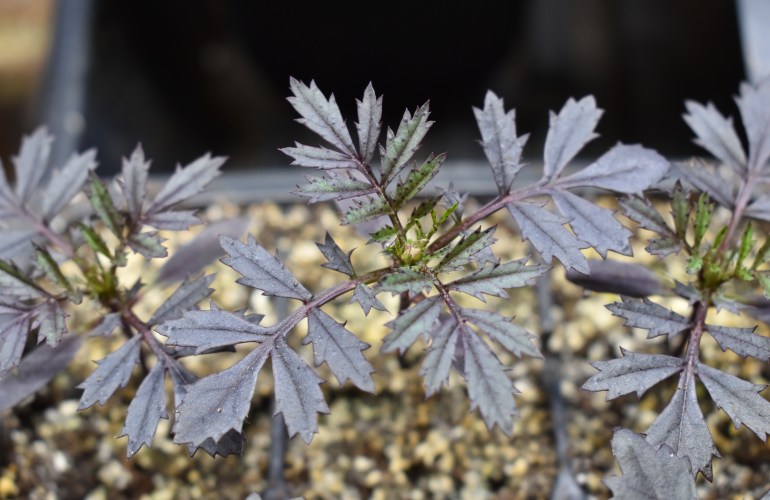
This spring, a whole flat of marigolds turned purple. So purple, they were almost black.
The marigolds, Durango Outback variety, have been garden stalwarts, the kind I don’t have to fuss with to get good performance. I like their pom-pom blooms, which show up well in dark areas of the garden with only a few hours of daily sun. Normally their leaves are green.
A quick Google search turned up a lot of discussion about purple leaves in tomatoes (see links below), but also plenty about marigolds. I’ve seen discolored leaves on marigolds before, but they look more like the photo here, with reddish-purple around the edges of the leaves. The color is anthocynin, a water-soluble pigment ranging from red-purple to purple-black that develops under a number of different conditions. Sometimes seedlings will tinge with anthocynin for a brief period of time in their stems, for example, as part of their natural development. Or, here, this basil variety will develop purple-red leaves that are normally high in anthocynin. (Younger seedling on left; in this case, I would get concerned if the color didn’t show up purple.)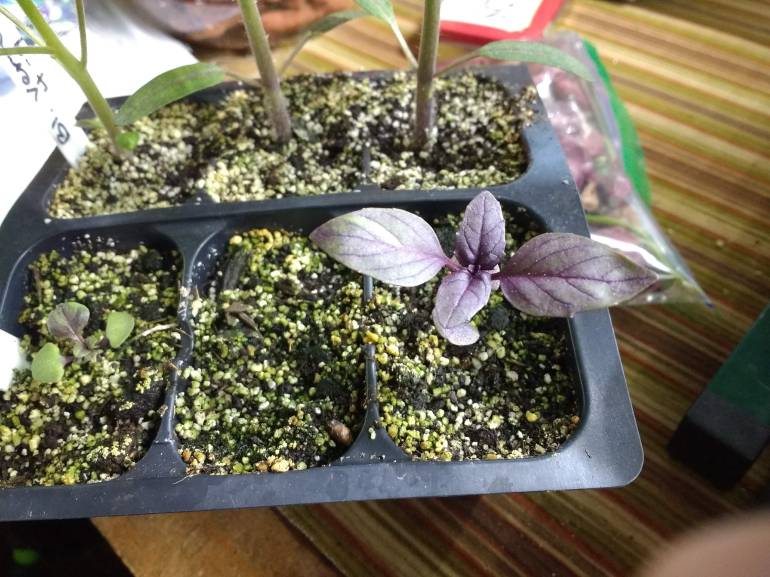
Anthocynin production is also a stress reaction that may help the plant survive a number of adverse environmental conditions, including cold, drought, light stress, and deficiencies in nitrogen, phosphorus, or both.
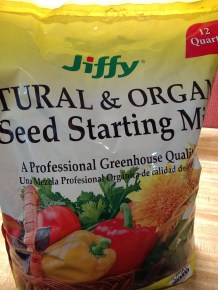
With regard to my marigolds, I ruled out cold and drought and started with nutrient considerations. Because I’d been growing in a soilless seed-starting mixture (Roots Organics Microgreens) that contains no added fertilizer, I’d supplemented with a liquid 2-3-2 Gardens Alive fertilizer at half-dose once per week. Giving a second half-dose feeding helped a little within a few days, but not much.
Before I gave them another feeding, I considered a third factor: my new lighting, a set of inexpensive shop lights I’d purchased to grow microgreens over the winter. The shop lights had performed well for trays of pea shoots and broccoli, sunflower, and lettuce microgreens. Given that success, I’d figured they’d do at least all right for seedlings, and in fact, most of my other seedlings were fine. (I’d even managed to get some micro tomatoes to flower under them.) Still, I moved half of the marigold seedlings to a full-spectrum grow light and left the other half under the shop lights. Within a few days, here’s what happened.
Shown above, the plants on the left have a few more days under the plant grow lights. I saw enough change within that time to convince me I’d hit on the solution.
Let’s talk a little more about those shop lights, because there’s a lot to know about lighting. For starters, visual perception of light and the specs on most lighting packaging don’t provide enough information for growers. What looks bright to the human eye might not be the right light for a plant at the intensity it needs. Although a whole winter of microgreens grew well under those inexpensive shop lights, crops that are grown simply for seedlings have different requirements from crops that are grown for mature plants. On top of that factor, each crop has a different set of light requirements for optimum mature growth.
 The takeaway: inexpensive shop lighting works all right for certain crops, but not for others. I’m sure there’s great variation among shop lighting, as well, and it’s difficult to determine exactly how much/what kind of light plants are receiving without a special light meter. I will continue to use the shop lights for certain crops and give my premium grow light space to those plants that need it.
Sources/ For Further Reading
Gardening Under Lights by Leslie Halleck. Available for free from Hoopla. This is such a great resource, I ordered a hard copy of it.
This gardener’s purple marigold leaves may have resulted from cold temperatures.
Causes of phosphorus deficiency. The fix is more complicated than adding more phosphorus.
Environmental Significance of Anthocyanins in Plant Stress Response.
Abiotic Stresses Induce Different Localizations of Anthocyanins in Arabidopsis.
Causes of tomato leaves purpling.
Brief YouTube video, phosphorus deficiency in tomato plants.
Purple leaf disorder in tomatoes.

 them in a 10% bleach solution for 10 minutes.
 few days.
 Perkins Park