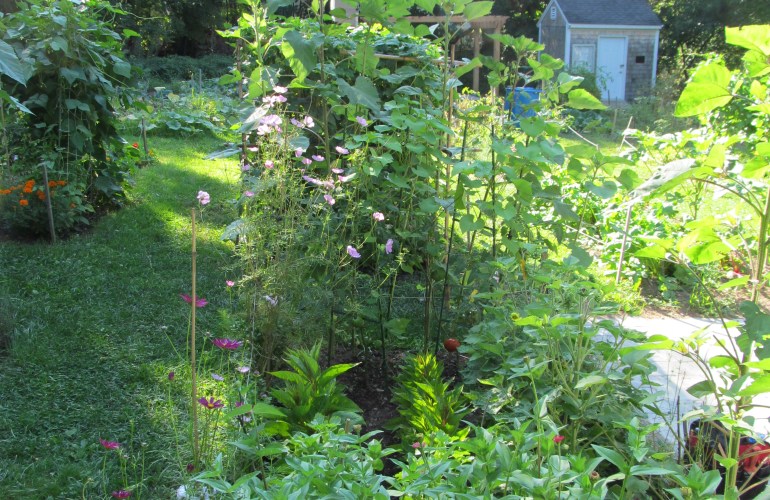
Louise and her husband Chuck joined PPCG in 2014, the spring after they escaped (Louise’s word) from Milwaukee, Wisconsin. She grows the most beautiful red oak leaf lettuces that decorate her garden like boutonnieres. For the first few seasons she planted them, I watched them grow tall and mangy, wondering why in the world she wasn’t eating them. It turns out she had another purpose for them…
Seed Saving
by Louise Quigley
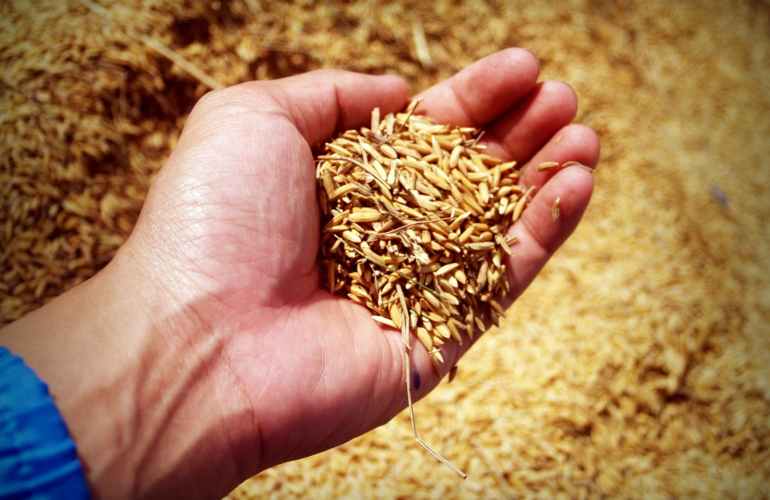
Agriculture began thousands of years before there were garden stores or seed catalogs. Until very recently, gardeners and farmers had seeds to plant in spring only if they saved seed from the previous year’s harvest. This can still be done, and there are good reasons to do it.
Why Save Seeds
Before the twentieth century, people all over the world bred seeds and slowly improved crops by saving seed from the best-performing plants each year, which produced thousands of varieties of each crop, each one adapted to its native soil and climate and with potential resistance to different pests or diseases. If one variety failed in a given season or soil or climate, there would be other varieties to fill in. But recent commercial agriculture has focused on offering the few crop varieties that are easiest to grow with farm machinery or for mass distribution. Often, these varieties are very high-yielding only because they’re hybrid seeds bred to respond to chemical fertilizers and requiring chemical pesticides. Locally adapted seeds were not profitable to offer in nationally-distributed catalogs, even though they were often tastier and better suited to various local conditions and organic practices. The result has been the unfortunate and potentially dangerous loss of some 75% of the crop varieties that existed just one century ago [Seed Savers Exchange Yearbook 2018, p. iii].
Saving seed and working with other seed savers enables you to grow varieties of garden crops not commercially available but which may be specially adapted to your conditions and organic growing methods. They’ll taste better than anything you can buy. At the same time, by growing heirloom crop varieties and saving and sharing the seed, you help preserve those varieties and the heritage they represent. And as a bonus, it’s fun and very satisfying.
How to Save Seeds
- Start with seeds of an “heirloom” or “standard” or “Open-Pollinated/OP” variety of whatever crop you want to grow. “Hybrid” or “F1” seeds will not breed true, and should not be used. Catalog descriptions should give you this information; if they do not, get seeds from a source that does. (See below for some useful catalogs.) Most garden store starts are hybrids, so unless they are marked as heirlooms do not use them for seed-saving.
- Plant your OP seeds as you usually would. Cool-weather crops like peas, spinach, lettuce, and radish can be direct-seeded, as can fast-growing warm-season crops like beans and corn. But saving seed from longer-season warm-weather crops like tomatoes and peppers will require starting them indoors between March and early April for planting after danger of frost in May.
- When saving seed from more than one variety of plants that could cross-pollinate with each other, pay attention to spacing them so as to avoid unwanted cross-pollination. For example, I place my two different heirloom lettuces in different areas of my garden space. If you want to save cucumbers or squashes, note that they can be particularly complicated in this regard. For details on this and all other aspects of seed-saving, I still rely on Suzanne Ashworth’s book Seed to Seed, though I note that Seed Savers Exchange has replaced this old “bible” with a newer book, The Seed Garden.
- Once the plants are growing, they have to be allowed to go to seed; for some but not all crops this takes considerably longer (and looks a whole lot… seedier) than just growing them to eat. Different techniques are needed for different crops. For example:
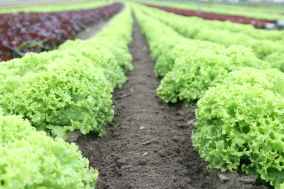
* When I save leaf lettuce, I harvest individual leaves rather than a whole plant, leaving enough of the plant to keep growing until it starts to send up a flower stalk. Leaves then become too bitter to eat, and I leave the plants to go to flower and produce seeds.
* 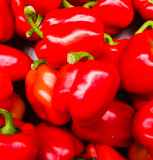 For peppers, simply let the fruits ripen fully, past green to yellow or red or whatever color that variety gets to. Choose one pepper from each of your plants of that variety, and when you cut them open you save the seeds that are in them and eat the cases as you ordinarily would.
*Tomatoes are harvested for seed when the fruits are ripe,  the same as peppers, but the seeds need special treatment. You may have noticed that fresh tomato seeds, unlike similar-looking pepper seeds, have a kind of gel around them. This must rot off before the seeds will grow. In nature, a ripe tomato falls to the ground and rots, and then its seeds sprout. In the kitchen, this process must be reproduced.
Cut open one tomato from each of the plants of a given variety. Squeeze a bunch of seeds from each fruit of that particular variety into a glass together. Add a little non-chlorinated water (I have a filter on my tap; otherwise use distilled water, or something similar: plain tap water in Braintree has enough chlorine in it to taste and smell, and the chlorine is there to inhibit the mold that in this case you want). You can then eat the rest of those tomatoes. Place the glass on the counter and check it daily; add non-chlorinated water as needed to make sure that the seeds do not dry out. After a few days, it will look scummy and start to smell really really bad. This is a good sign, and indicates that the rotting process is proceeding correctly. After a few more days, it will no longer look very scummy or smell so much. This indicates that the rotting process is complete. Pour out the water and scum, retaining the seeds, and spread them on a plate to dry for a few days. Once they are quite dry, save them in a labelled baggie in a cool dry place (as described below).
*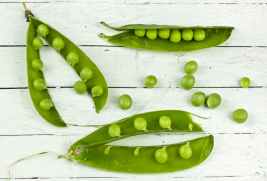 With peas and beans, which produce multiple pods on each plant, I harvest some or most of what grows for eating while leaving one or two pea or bean pods on each of the better plants to mature into viable seed (they’re ready when the pods turn brown and dry).
* Then there are the crops like carrots and parsley, which are biennials: their first year they just make roots and leaves, and you have to leave a few of the best ones in the ground to overwinter so they can put up their flower stalks in their second growing season.
And so on. Consult a book like The Seed Garden for all the details.
- Once you have harvested viable seeds, you may need to remove any hulls or pods from the actual seeds. Do this for one crop variety at a time, and then place each variety’s seeds in their very own baggie and Label It clearly with the crop type, variety name, and year. Do NOT even think about trying to remember all winter which seeds were in which baggie!!!! Really!! Save them in a cool dry place (I use my frost-free fridge, which keeps them viable over the winter just fine).
This is all a bit more to do than just going to the garden store and buying what they have there. But it enables you to grow crops and crop varieties that the garden stores don’t sell. For example, the original snap pea, Sugarsnap, which I grow and save, has been superseded in many catalogs by its descendants, but is still my favorite. Matt’s Wild Cherry Tomato, a unique kind of cherry tomato, was collected from the wild near Mexico City by someone named Matt and offered only through Johnny’s Selected Seeds; I do not know of any other sources besides Johnny’s and SSE. The McClintock tomato that I grow is available only from SSE. The rarity of many wonderful varieties is therefore one reason to save seed. In addition, it is enormously satisfying and a lot of fun to complete the circle from seed to plant to seed to plant again. And it makes you part of the effort to preserve the crop biodiversity that we’ve inherited. Give it a try!
Useful Sources of Seed
Seed Savers Exchange started in 1975 as a small group and has expanded to about 350 “listed members” who offer seed each year (I have been a listed member for over 20 years now). SSE encourages gardeners to join the exchange, save seed, and share it with each other through an annual Yearbook with over 10,000 listings, all open-pollinated. Nonmembers too can buy seed of many of the Yearbook’s offerings, and can also buy from SSE’s regular (ordinary-size) catalog. Find the online yearbook at exchange.seedsavers.org The website for the catalog is www.seedsavers.org SSE’s snail mail address is 3094 North Winn Road, Decorah, IA 52101.
Other seed catalogs I’ve used that note which offerings are heirloom/ open-pollinated versus hybrid:
Johnny’s Selected Seeds, 955 Benton Ave., Winslow, ME 04901-2601
Seeds of Change, PO Box 152, Spicer, MN 56288
Park Seed, One Parkton Ave., Greenwood, SC 29647-0001
Pinetree Garden Seeds, or hello@superseeds.com, PO Box 300, New Gloucester, ME 04260
Territorial Seed Company, PO Box 158, Cottage Grove, OR 97424-0061
Burpee, 300 Park Ave., Warminster, PA 18974


 the shovels and pitchforks and hoes and rototillers? Hold on…the more I’ve been reading and learning about soil, the more convinced I am that the less you work your soil, the better. Here is one case where laziness–no more back-breaking double digging–might be better for the long-term health of your garden.
 them in a 10% bleach solution for 10 minutes.
 few days.
 Perkins Park